 Overview
Game of the Generals (also known as GOG or GG) is a Filipino board game where each player controls an army of pieces with hidden identities. It emphasizes bluffing, memory, and strategy rather than pure calculation.
 Origin
The game was invented in the Philippines by Sofronio H. Pasola Jr. in 1970. Its Filipino name is “Salpakan”.
 Objective
The main goal is to eliminate or capture the opponent’s Flag. Another victory route described in common rulesets is to successfully maneuver your own Flag to the far edge of the board under specific conditions.
 Board & Pieces
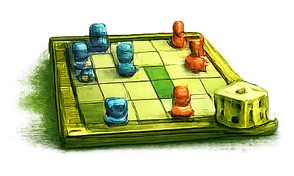
- The board is a rectangular grid (commonly described as 9×8 squares).
- Each player has a set of pieces including a Flag, Privates, Spies, and officer ranks.
- Piece identities are hidden from the opponent (ranks are shown on the back side facing the owner).
- Players alternate turns and move one piece per turn.
- Pieces move one square up/down/left/right.
- No diagonal movement and you cannot move into a square occupied by your own piece.
 Hidden Information
Unlike chess, you don’t know what you’re attacking until a confrontation happens. This creates a “fog of war” feel—players must deduce, bait, and mislead.
 Challenge
A battle occurs when a piece enters a square occupied by an opposing piece. The result is determined by the hierarchy/rank of the two pieces (higher rank typically wins; equal ranks can both be removed). Some pieces have special interactions (commonly: Spy and Private).
- Capture / eliminate the opponent’s Flag to win.
- Some rules allow winning by bringing your Flag to the opponent’s back edge and meeting specific “survive a turn / no challenge” conditions.
 Arbiter / Referee
Many descriptions of the classic game include an optional neutral arbiter/referee who helps judge challenge outcomes while keeping the losing piece’s identity hidden from the winner. (Digital versions typically automate this.)
 Quick Facts